14 hits
By

We recently reported in Chemical Science a simple, universal method to directly determine absorption cross-sections from one-photon to multiphoton regimes. By exploiting the saturation behavior of transient-absorption signals, our protocol sidesteps the demanding requirements of conventional techniques—no tight high-intensity focusing, detailed sample-morphology knowledge, or reliance on photoluminescence is needed.
Applying this approach, we directly measured three- and four-photon absorption cross-sections of CsPbI₃ perovskite nanocrystals and CdSe/ZnS quantum dots at 1700 nm and 2100 nm, finding values at least an order of magnitude larger than many materials commonly used for deep-tissue imaging. Because the method does not depend on emission, it is equally applicable to weakly emissive or non-emissive light-harvesting materials.

Similar excited-state filling dynamics regardless of excitation pathway.
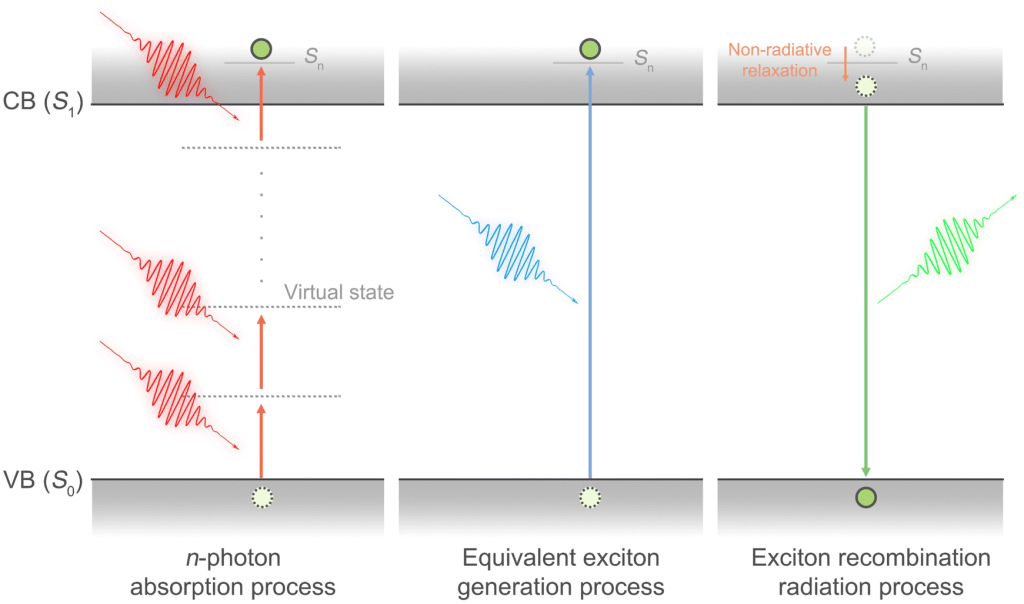
Since both single-photon and multi-photon absorption lead to exciton formation at the same excited state, we posit that a given multiphoton absorption process when corrected for the photon fluence and absorption cross-section can be considered as equivalent to a single-photon absorption process that generates the same average number of excitons or the filling of the lowest excited state.
The framework unifies one- and multi-photon processes because the same final excited state shows very similar excited-state filling dynamics, producing nearly identical transient-absorption signatures regardless of excitation pathway. We assessed the method’s limits and found them sufficient for most state-of-the-art photon-harvesting systems; theoretical analysis points to practical routes for extending the measurable range.
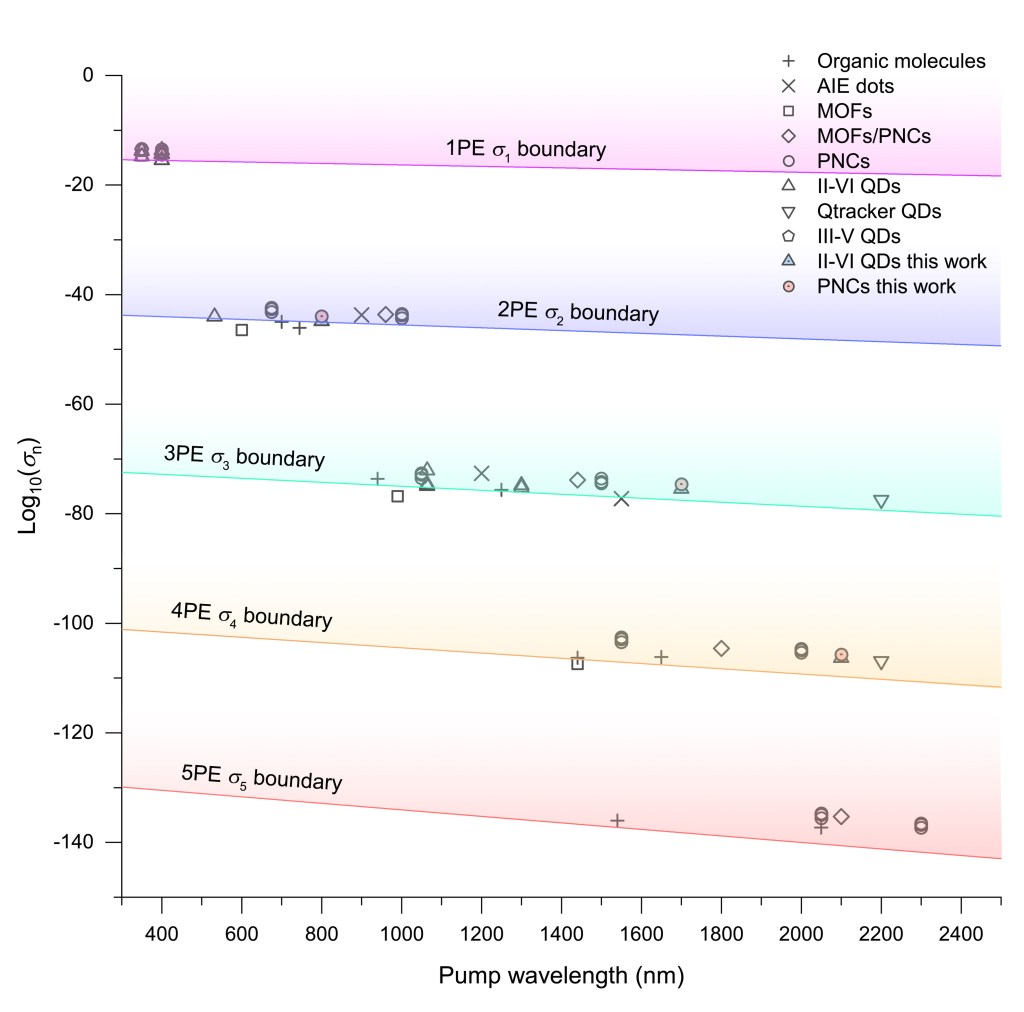
Calculated measurable σn boundaries of the system (the vertical axis represents the logarithm of σn) and state-of-the-art σn of existing materials, demonstrating the universality of our measurement system.
As a compact, generalizable “multiphoton spectroscopy engine,” this transient-absorption platform accelerates the discovery and optimization of next-generation photon-harvesting materials, with clear implications for advanced microscopy, photochemistry, and optical technologies.
This work was selected as a HOT article in July 2025. HOT articles are chosen by the Editors based on exceptionally strong reviewer comments and are prioritised for further promotion.
Read more: Direct determination of multiphoton absorption cross-sections by transient absorption spectroscopy, DOI: 10.1039/D5SC03392F.


 zeon photonics
Leave a comment