Photonic-Functionalized Framework Chemistry
I am interested in the strategic integration of photon-active units—organic chromophores, quantum dots, etc.—into metal–organic frameworks (MOFs) via grafting, coordination-encapsulation, or host–guest assembly. Framework chemistry offers an exceptional platform to maximize the functional output of these units and, in some cases, to elicit emergent properties not seen in the isolated components. The idea of “unlocking” a unit’s latent potential through rational framework design is particularly compelling and motivates my work on tuning exciton transport, energy-transfer pathways, and emission behaviour in realistic environments.

Graphic illustration of advantages provided by MOF strategy to develop host-guest microlasers.
Related Publications:
1. H. He, et al., Controllable Broadband Multicolour Single-Mode Polarized Laser in a Dye-Assembled Homoepitaxial MOF Microcrystal. Light Sci. Appl. 2020, 9, 138.
2. H. He, et al., Confinement of Perovskite-QDs within a Single MOF Crystal for Significantly Enhanced Multiphoton Excited Luminescence. Adv. Mater. 2019, 31, 1806897.
3. H. He, et al., MOF-Based Organic Microlasers. Adv. Opt. Mater. 2019, 7, 1900077.
4. H. He, et al., Periodically Aligned Dye Molecules Integrated in a Single MOF Microcrystal Exhibit Single-Mode Linearly Polarized Lasing. Adv. Opt. Mater. 2017, 5, 1601040.
5. H. He, et al., Polarized Three-Photon-Pumped Laser in a Single MOF Microcrystal. Nat. Commun. 2016, 7, 11087.
In-situ Liquid-Phase TEM Characterization
High-quality nanocrystal synthesis and storage typically rely on solution chemistry. Ionic or “soft” crystals often exhibit far richer structural dynamics in solution than in the dry state, which complicates system analysis. In-situ liquid-phase TEM provides a direct way to observe nanoscale structural dynamics and correlate them with changes in optical and functional performance. Although electron-beam effects on soft materials are non-negligible—necessitating careful parameter selection and experimental control—this technique remains a powerful, worthwhile approach for probing mechanism-driven materials behaviour.
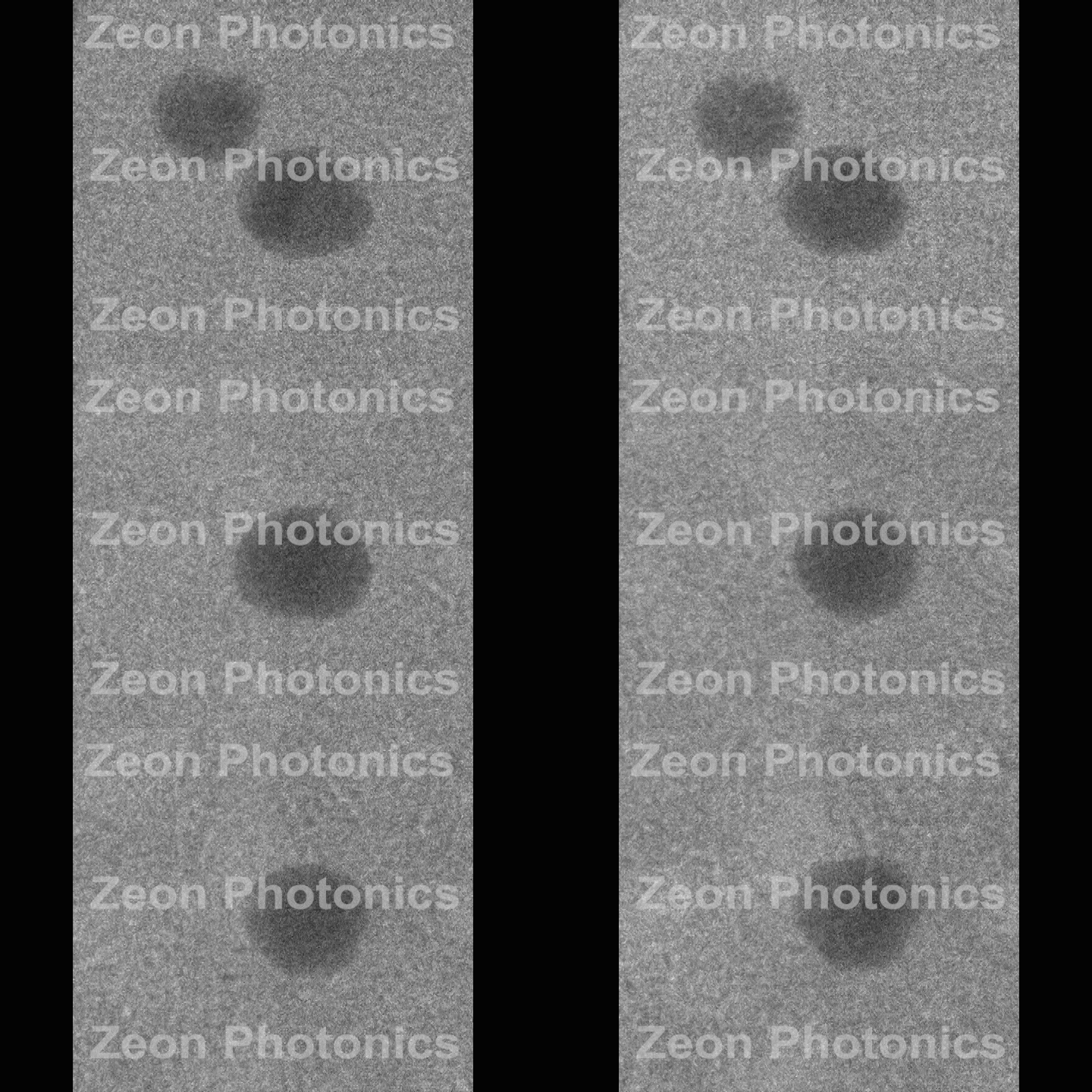
In-situ liquid-phase TEM capturing the fusion of two “soft” nanoparticles
Related Publications:
1. H. He, et al., Aqueous Colloidal Perovskite Quantum Emitters. Adv. Mater. 2025, 2500349.


 zeon photonics